
Overview
Eddy current testing is a very common method used to inspect seamless and welded metal pipes. Many standards also require this testing. However, you may not know that eddy current testing utilizes the principle of electromagnetic induction.
This article will detail the principles of eddy current testing, as well as its advantages and disadvantages. Read on to understand why this testing method is highly suitable for pipe products.
What is Electromagnetic Induction?
Electricity and magnetism are both familiar concepts in our daily lives. Electricity generates currents, which allow our electrical appliances to operate. Magnetism, on the other hand, can attract and repel each other, and can also attract certain metal materials.
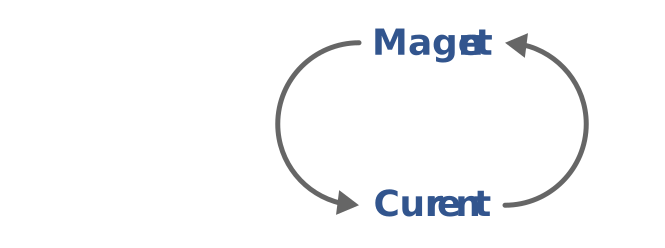
Remarkably, these two physical phenomena are actually interconnected. Electric currents can generate magnetic fields, which can be used to move objects—this is the principle behind electric motors. Conversely, magnetic fields can also generate currents, and eddy current testing utilizes this physical phenomenon.
What is Eddy Current Testing?
Eddy current testing uses electromagnetic induction to detect defects in metals. Below, we'll explain the concepts related to eddy current testing in detail:
What is Metal Defect?
Defects are imperfections that affect metal properties, such as cracks and pores. They can exist on the surface or internally.
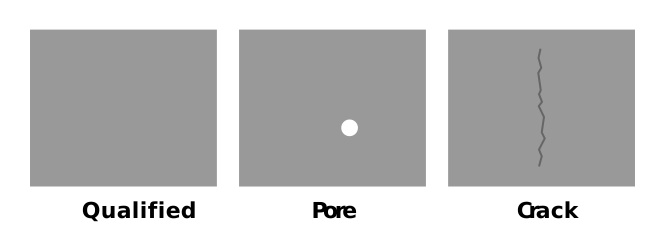
These defects can cause corrosion. If the metal is subjected to high temperatures and high pressures, these defects can also cause the material to fracture. Therefore, defects in metals are unacceptable. We must prevent these defects before the material is used. Eddy current testing can detect these defects and sort out unqualified products.
What is Eddy Current?
We explained the phenomenon of electromagnetic induction above. Magnetoelectricity is one such phenomenon. A typical application scenario is passing a magnet through a metal coil, which generates an electric current.
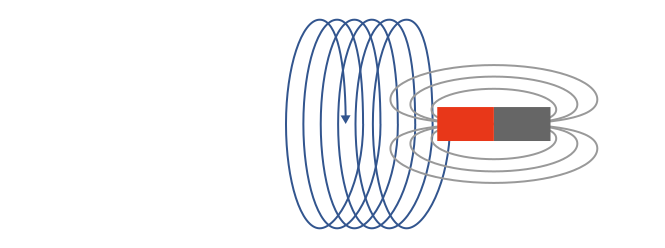
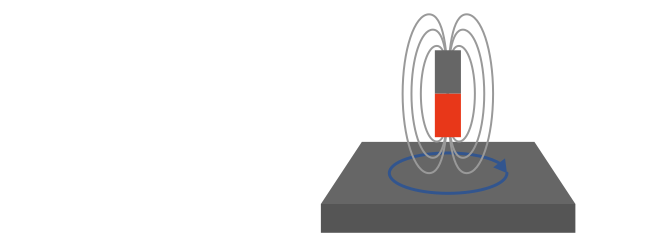
However, if a magnet is placed near another solid metal and continuously moved, current will also be generated in the metal. Because there is no coil, the current cannot propagate along a fixed path. Instead, the current forms a loop within the metal. This looping current is called an eddy current.
Principle of Eddy Current Testing
Eddy current testing utilizes the eddy current phenomenon to inspect metal materials. When a magnetic field moves near metal, circular eddy currents form within the metal.
If the metal is free of defects, the eddy currents form a perfect ring. However, if there are cracks or pores within the metal, the current cannot flow through it and instead flows around the defects, forming an irregular current.
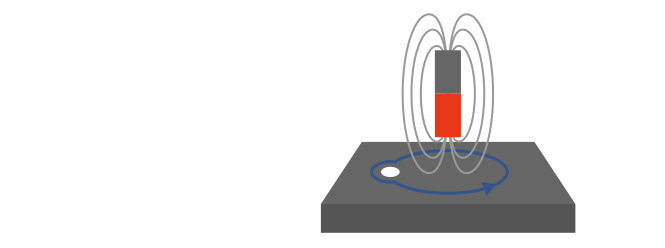
Therefore, simply observing the shape of the current can determine whether the metal has passed the test. If the current forms a perfect ring, the metal is free of defects. Conversely, if the current forms an irregular shape, the metal is unqualified.
Applications of Eddy Current Testing
Eddy current testing is suitable for inspecting most metals. However, in practice, pipes are most commonly tested using eddy current testing.
For sheet metal products, due to their flat shape, eddy current testing requires multiple locations to cover the entire material, rather than a straight line, making automation difficult.
For bars, due to their solidity, the magnetic field is difficult to evenly distribute throughout the material, which also affects the inspection performance.
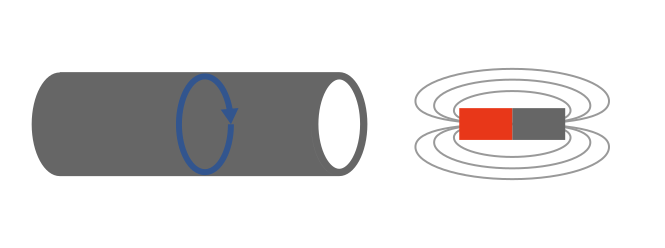
On the other hand, pipes are hollow, providing ample space for the magnet to pass through. Furthermore, their elongated shape allows the magnetic field to move along a single line for inspection, making automation highly feasible.
Advantages and Disadvantages
Eddy current testing has many irreplaceable advantages. First, since testing only requires moving the magnet, it is highly automated and offers high inspection efficiency. Second, eddy current testing is unaffected by temperature and can be performed on materials at high temperatures. Finally, in addition to detecting defects, it can also measure other physical properties such as conductivity.
The disadvantages of eddy current testing are also obvious. First, its inspection depth is relatively small, which is why it is more commonly used for inspecting pipes. Secondly, eddy current testing can only work on conductive materials. Finally, eddy current testing can only see the change in current and cannot determine the shape and nature of the defect.
FAQ
What is non-destructive testing?
Non-destructive testing refers to testing that does not damage the material. Common non-destructive testing methods include ultrasonic testing (UT), penetrant testing (PT), eddy current testing (ET) and etc. The advantage of these testing methods is that they maintain the integrity of the material without the need for sampling. Therefore, they can achieve 100% inspection.
How do I decide whether to use hydrostatic testing or eddy current testing?
Hydrostatic testing and eddy current testing are both effective methods for inspecting pipes. They operate on different principles and have different testing purposes. Hydrostatic testing primarily tests the pressure-bearing capacity of pipes, while eddy current testing detects defects. However, there is a certain correlation between pressure-bearing capacity and defects. Therefore, in some standards, only one of hydrostatic testing and eddy current testing is required. However, for some stringent standards, both tests are required.
Further Reading



Conclusion
Eddy current testing utilizes the physical phenomenon of eddy currents to inspect materials. It is a nondestructive testing method. Its purpose is to detect defects such as cracks and pores. Irregular eddy current patterns indicate that the material is unqualified. Eddy current testing is primarily applicable to pipes.
We produce nickel alloy pipes in various materials and perform hydrostatic testing or eddy current testing on them in accordance with strict requirements. Please contact us if you have any inquiries.

